
Reading the verdict
When an experiment finishes, the results page reads top to bottom in one order: the verdict, then Why it won, then the evidence. This page walks through each part so you can tell what Squoosh decided, why, and what to do next.
Your experiment compares two pages: Control page (A), your current page, and Variant page (B), the version you supplied. The results page reports which one converted better on your goal.
The verdict band
The band at the top states the outcome in one line, with the lift and the confidence beside it.
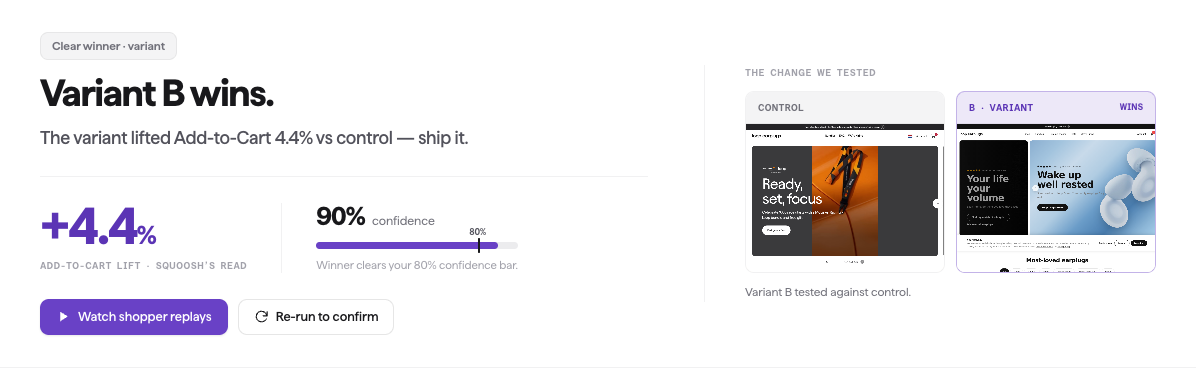
The verdict band: the outcome, the lift, the confidence, and the change that was tested.
The headline is one of three outcomes:
| Headline | What it means | What to do |
|---|---|---|
| Variant B wins | Variant page (B) beat the control on your goal. | Ship version B. |
| Keep the original | Variant page (B) did worse than the control. | Keep your current page live. |
| Too close to call | Neither page separated from the other. | Re-test with a sharper change. |
Keep the original is a real result, not a failure. Knowing a change would cost you conversions is worth the test. A small chip next to the experiment name restates the outcome.
Beside the headline, the band shows two numbers:
- Lift — how much version B changed your conversion rate versus the control, as a signed percent, with a 95% CI range under it.
- Confidence — how sure Squoosh is that the result is real, on a meter marked at the 80% bar Squoosh uses to call a winner.
The lift Squoosh shows is the measured difference between your two shopper groups — the variant's conversion rate versus the control's — not a discounted estimate. For how to read both numbers, see Reading lift and confidence. For how the two combine into the outcome, see How Squoosh decides a winner.
The band's action buttons let you watch the shopper replays or re-run the test. There is no ship button — see You decide.
Note
A higher raw number in the table doesn't always win. When version B's conversion rate ran higher but the change didn't earn that lift, the verdict still says Keep the original and explains why. The headline reflects Squoosh's read, not the raw rate alone.
Why it won
Directly under the verdict, the Why it won section explains the result the way an experienced conversion analyst would — read the outcome, then read why. Every completed experiment gets one; an inconclusive run reads What we learned instead and never invents a winner that isn't there. It has three parts:
- Squoosh's read — a short, plain-language summary of what separated the two versions: what changed, what shoppers noticed, and why it moved (or didn't move) the decision.
- Issues they hit — the friction shoppers ran into, grouped by area (for example Trust & Security, Navigation, Product), so you can see what to address next.
- In their words — a rail of quote cards showing individual shoppers in their own words. Each card carries the shopper's name and persona, a verbatim quote, and whether they Added to cart or Did not convert. Squoosh surfaces the shoppers who decided differently between the two pages, because those decision-flippers explain the result. Click any card to open a paired replay — the same shopper's session on Control page (A) and Variant page (B) side by side, so you can watch where the two versions sent them in different directions.
The evidence
Below "Why it won," the evidence section — How we know — the proof — shows the numbers behind the verdict.
Result detail
A table compares the two pages side by side. Each row is one version — Control and B · {your variant name} — and shows that version's conversion rate, its change versus the control, and a result marker. The winning row is enlarged, and the Confidence is restated below it.
The result markers are short chips:
| Chip | Meaning |
|---|---|
| Winner | This version won the experiment. |
| Flat | No meaningful difference from the control. |
| Lost | This version converted lower than the control. |
| Control | The baseline that version B is measured against. |
Lift by segment
A bar per audience segment shows each segment's change versus the control. A change can help one segment and hurt another, so the bars can point in opposite directions. They blend back to the single headline lift — use them to see who a change worked for, not as separate verdicts.
You decide
Squoosh never applies a change to your site. There is no ship or deploy button. The verdict is a recommendation backed by evidence; rolling out version B is your call.